Competition · Traditional martial arts
Traditional Chinese Martial Arts Competition
“What is scored is what does something to an opponent.”
A tournament for everyone who trains the traditional way – and who wants to find out, once, where they stand. Not a showcase, but a place where years of quiet practice can finally be measured against practitioners of other schools, other lineages, other countries.
A movement that no longer does anything is no longer a martial art. It is a picture of one.The standard of this tournament
Why this competition exists
Traditional Chinese martial arts are not disappearing because nobody practises them any more. They are disappearing because almost everywhere they are judged by a standard built for a different sport.
Since the standardised forms of 1956, and unmistakably since difficulty scoring arrived in 2003, competitive wushu rewards what jumps high, stretches far and impresses from a distance. That is a demanding, honest athletic sport – it is simply a different one from the art its forms once came from. A traditional practitioner who enters that grid either loses or adapts. Both cost the same thing: the application.
This tournament is the counter-test. It treats traditional and modern Chinese martial arts as two different sports – not as a better and a worse version of one. And it gives the first of them what it needs to survive: a place where its own standards apply, where work is compared, questioned and exchanged, and where a path walked without an audience finally pays off.
The distinction we work with follows the study “Tradition vs Modern Wushu” in the Oyang Archive. It separates neither by age nor by pedigree, but by whether a movement still has a job to do.
What gets scored
Four standards. They are printed here in full so that nobody has to guess what they are competing for – and so that the judges are held to the same measure as the competitors. The standards and the scoring system were developed from the article Traditional vs Modern Wushu in the Oyang Archive.
-
Application yòng fǎ
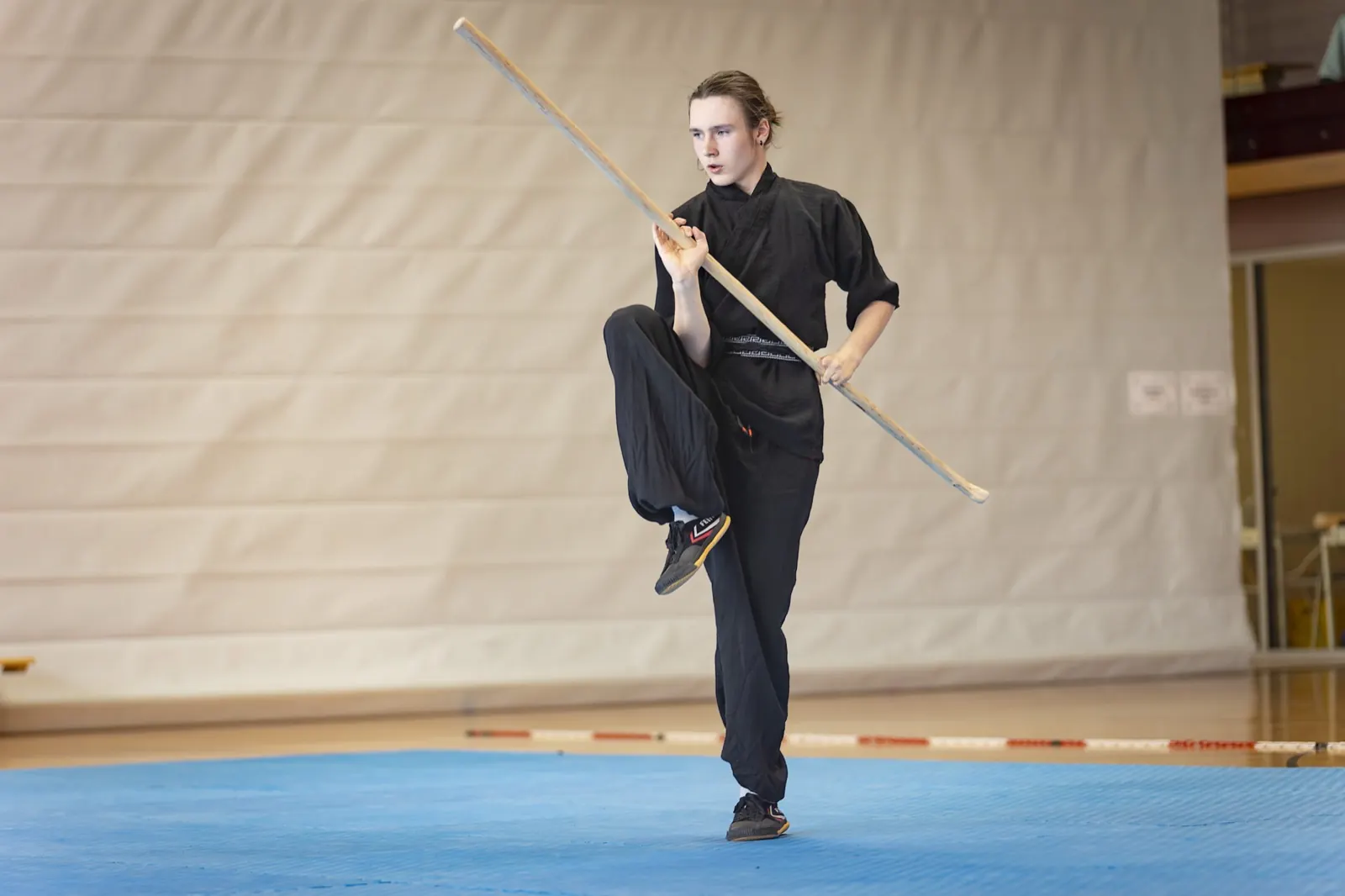
The real touchstone. Every stance, every transition, every hand must do something against an opponent. If you perform a form, you should be able to say what a movement is for – and show it. An application need not be the only one; it only has to be one.
-
Structure over amplitude
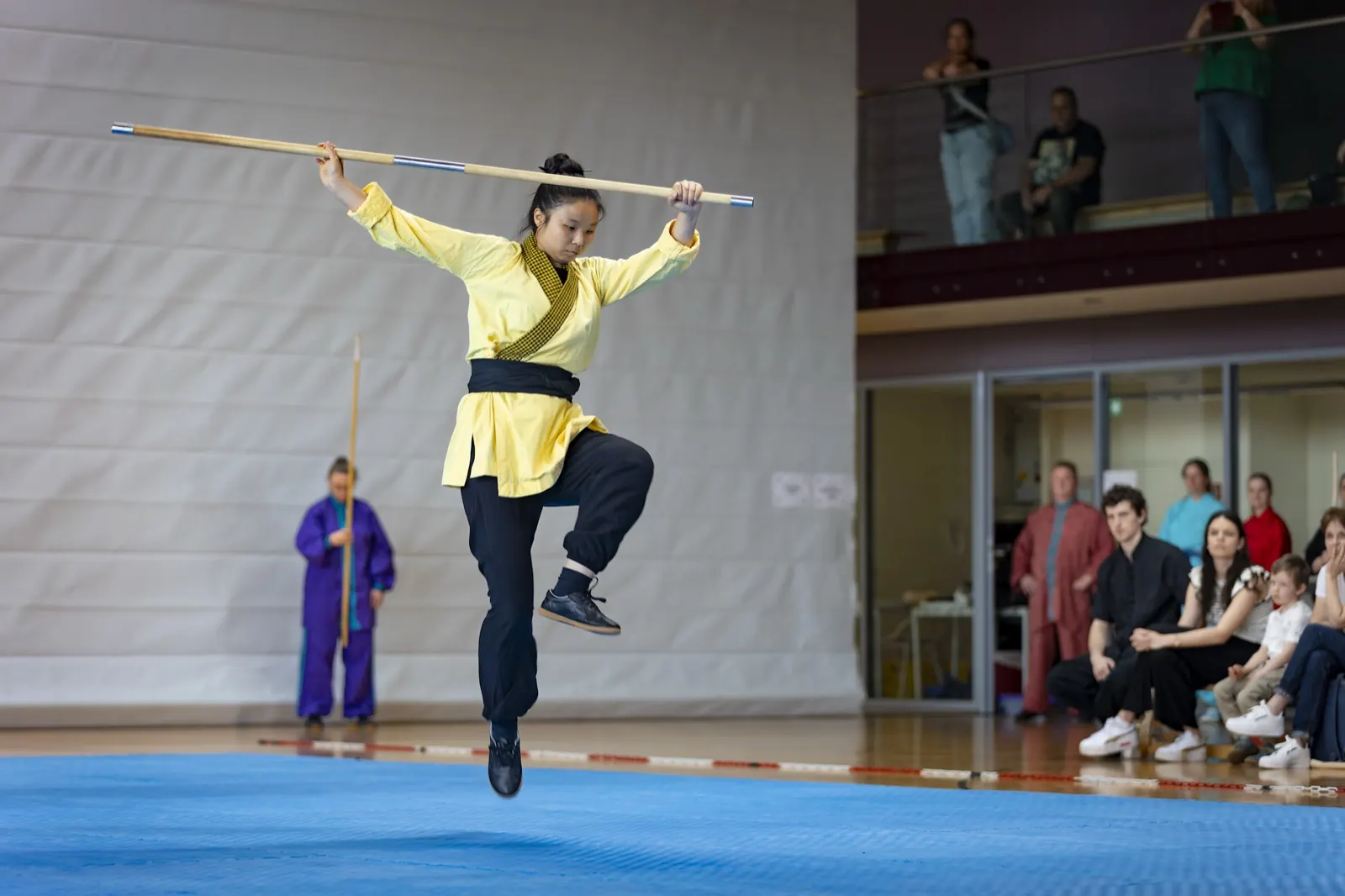
Root, axis and power transmission are what count: does the structure hold under pressure, does the force arrive from the ground, does the trunk carry the movement? Jump height, leg extension and the sound of the landing earn no points here. They are not faults either – they simply do not count.
-
Lineage and origin
Style, teacher and the origin of the form are stated at registration. A pedigree decides nothing – old lineages have swapped content too – but it belongs to the picture, and it is what makes the conversation after the tournament possible.
-
Martial virtue 武德
Wude. How you treat your opponent, the judges and your own lineage is part of the score. Whoever steps onto the floor represents their school – and whoever loses, loses in front of people who practise the same thing.
Who may enter – and who receives a score
We exclude nobody. But we do not pretend everything is the same thing either.
Traditional martial arts
Forms whose construction carries a recognisable combat logic – from any country, any school, any century.
- Empty-hand forms with an explicable application
- Weapon forms in which the weapon is handled as a weapon
- Free application demonstration at the judges' request
Awards are given in this division only.
Modern and modernised wushu
Anyone coming from modern competitive wushu is expressly invited – as a competitor, as a guest, as someone to talk to.
- Modern competitive wushu (taolu with difficulty scoring)
- Modernised traditional forms: old name, new standards
- Newly assembled forms without a continuous combat logic
- Demonstrations outside the competition
A slot, the floor and feedback from the judges: yes. Awards: no.
Internal styles do not compete
Internal styles and the practices of inner cultivation are not part of the scoring. They exist for the work a person does on themselves – not for display, and certainly not for comparison. A judge cannot score them without distorting them.
Partner and group forms: not yet
For now we score solo forms only. Partner forms, choreographed application sets and group forms are categories we want to add as soon as the number of entries can carry them.
Who should enter
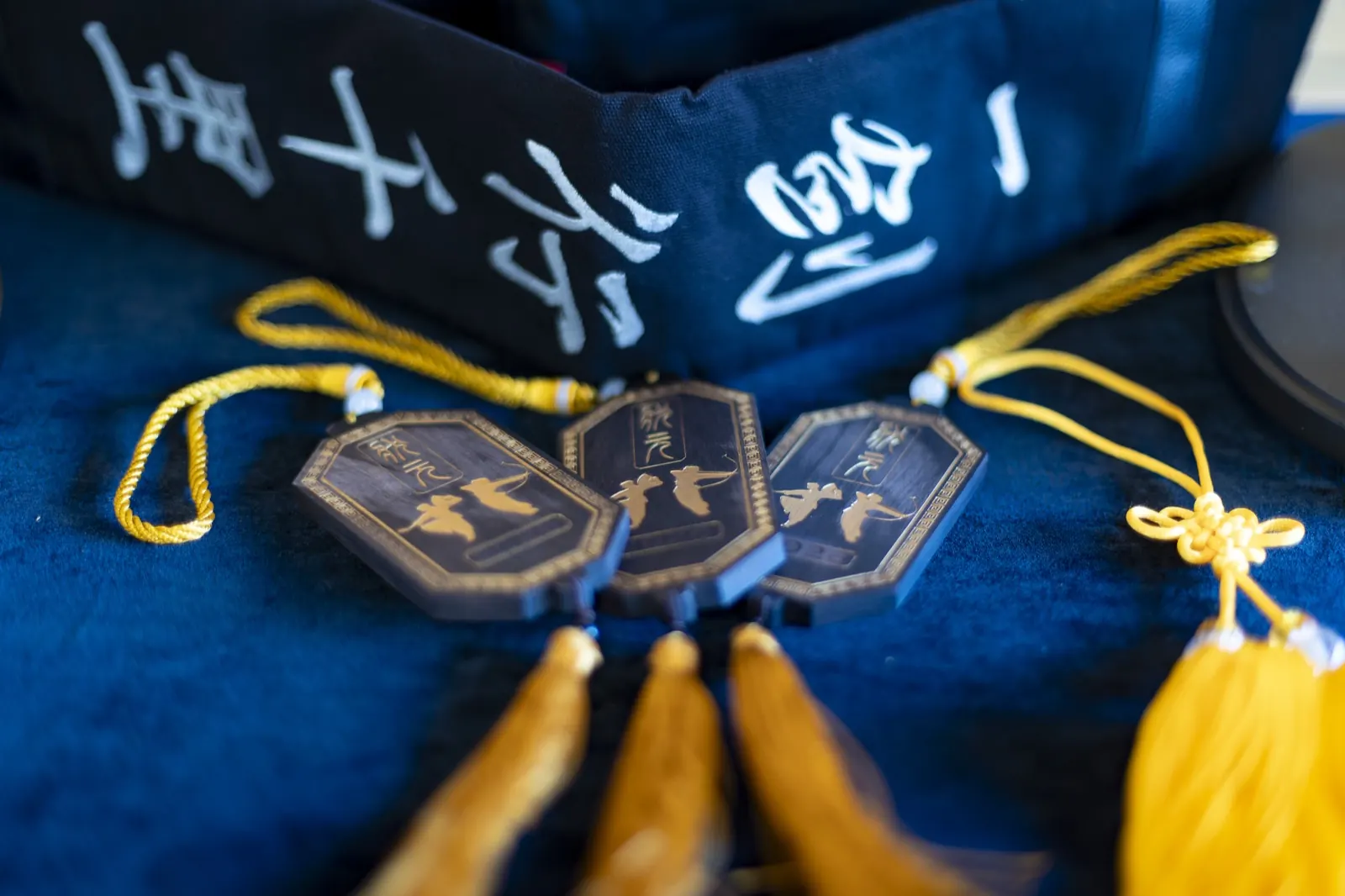
Practitioners of any lineage
North or south, internal or external, club, family line or private tuition: if you practise a form that still does something, you belong here.
Teachers and schools
Enter your students as a group. For many of them it will be the first competition that asks about the application instead of handing out a mark for execution.
Spectators and the curious
You do not have to compete to come. If you want to know how the two paths actually differ, one day here shows it more clearly than any essay.
Age groups, experience divisions and the permitted weapons are listed on the first page of the registration form.
Registration
Date, venue, entry fee, divisions and schedule are on the first page of the form – that is where they are kept up to date, so this page cannot claim anything stale.
Open the registration form
The form is hosted by Google Forms. If you load it here, your browser connects to Google and transmits your IP address; cookies may be set. Without this click, none of that happens.
Rather not embed it? Open the form directly at Google · Privacy
Questions about registration, divisions or getting here? Write to mail@huadezhongxin.org or call +49 351 7992260.
Also running: the Imperial Hunt
Our second competition, same standard, arrow instead of fist: a 3D course with additional challenges, open to anyone who shoots the traditional way.